Table of Contents

In the realm of modern prosthodontics, the selection of restorative material is a decision that balances biomechanical necessity with aesthetic aspiration. For decades, feldspathic porcelain was the undisputed gold standard for its ability to mimic the light-reflecting properties of natural enamel. However, the introduction of zirconium dioxide (Zirconia) often referred to as “ceramic steel” has fundamentally altered clinical protocols. Choosing between Zirconia and traditional porcelain is no longer a matter of one being superior to the other; rather, it is about identifying the specific oral environment, occlusal forces, and aesthetic goals of the individual patient.
The Structural Integrity of Zirconia
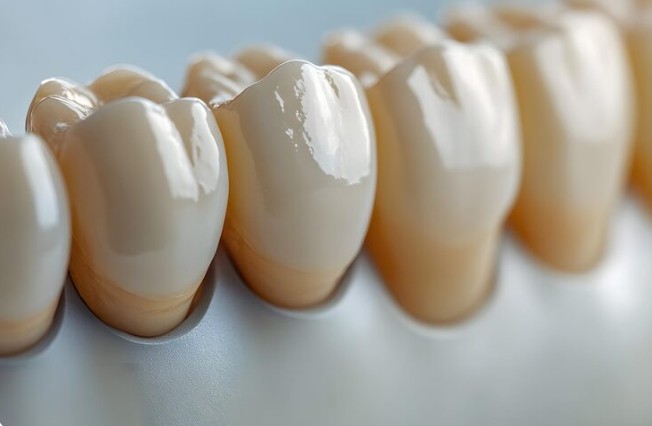
Zirconia is a crystalline oxide of zirconium, categorized as a high-performance technical ceramic. Its primary advantage lies in its extraordinary flexural strength, which can exceed 1,000 to 1,200 Megapascals (MPa). To put this in perspective, traditional glass-ceramics typically offer a strength of 100 to 400 MPa. This high fracture toughness makes Zirconia the preferred choice for posterior restorations—the molars and premolars—where the force of mastication is at its peak.
Beyond its strength, Zirconia is celebrated for its biocompatibility. It is chemically inert, meaning it does not react with oral fluids or provoke allergic responses, which is a common concern with older porcelain-fused-to-metal (PFM) restorations. Furthermore, Zirconia crowns require less tooth reduction during the preparation phase because the material can be milled into thinner, more resilient walls while maintaining structural integrity.
Talk to a Turkeyana consultant
Free evaluation and an all-inclusive quote within 24 hours.
The Aesthetic Artistry of Porcelain
While Zirconia dominates in durability, traditional all-ceramic porcelain remains the “aesthetic champion.” Porcelain’s molecular structure allows for a high degree of translucency, enabling light to pass through the restoration and reflect off the underlying tooth structure, much like natural enamel. This quality is vital for anterior restorations—the “social six” teeth that are visible when a person speaks or smiles.
Porcelain can be hand-layered by master ceramists to include subtle internal characterizations, such as mamelon structures, cervical shading, and incisal opalescence. For patients whose primary goal is a restoration that is indistinguishable from their natural teeth, even under close inspection or varying light conditions, high-quality porcelain remains the gold standard. However, porcelain is inherently more brittle and carries a higher risk of chipping if subjected to parafunctional habits like bruxism (teeth grinding).
The Hybrid Solution: Layered Zirconia
Modern dentistry has found a middle ground through “Layered Zirconia” or “Porcelain-fused-to-Zirconia” (PFZ). This technique utilizes a strong Zirconia core for structural support, which is then veneered with a layer of aesthetic porcelain. This hybrid approach aims to provide the best of hem both worlds: the fracture resistance of a Zirconia framework with the lifelike appearance of a porcelain surface.
Clinicians often recommend this for front-row teeth where the patient has a heavy bite or a history of breaking traditional ceramics. However, the interface between the two materials requires meticulous laboratory work to prevent “delamination” or chipping of the outer porcelain layer over time.
Clinical Decision-Making: Location and Lifestyle
The decision-making process in a professional clinical setting typically follows a specific set of criteria:
- Location of the Tooth: Molars generally require the monolithic strength of Zirconia, while incisors favor the translucency of porcelain.
- Occlusal Clearance: If a patient has a “tight bite” with little room for a thick crown, Zirconia’s ability to remain strong in thin sections is a deciding factor.
- Aesthetic Demands: Patients with high aesthetic expectations often opt for the depth and “life” provided by layered porcelain.
- Oral Habits: For patients who clench or grind their teeth, monolithic Zirconia is often the only safe option to avoid repeated fractures.
The Economic and Longevity Factor
When viewed as a long-term investment, both materials offer high value but different lifespans. Monolithic Zirconia crowns are virtually indestructible and can last 15 to 20 years with proper hygiene. Porcelain restorations, while durable, may require more frequent maintenance or replacement after 10 to 12 years due to minor chipping or wear against opposing natural teeth. In the context of dental tourism, the efficiency of CAD/CAM (Computer-Aided Design and Manufacturing) often makes Zirconia a faster and more cost-effective option for full-mouth rehabilitations.
In the pursuit of dental restoration, the expertise of the executing clinic is as vital as the material itself. Turkeyana has distinguished itself by offering a curated approach to material selection, ensuring that every crown or veneer is matched to the patient’s biological needs. With an in-house laboratory utilizing the latest CAD/CAM technologies and a team of specialists dedicated to clinical precision, the clinic guarantees that your choice between Zirconia and porcelain results in a functional, healthy, and radiant smile. Turkeyana’s commitment to using only the highest-grade international materials ensures that international patients receive world-class care that stands the test of time.
Your feedback helps us improve.
Thank you for your feedback.