Table of Contents


The realm of cosmetic dentistry is frequently misunderstood as a purely mechanical discipline—a straightforward process of whitening, straightening, or replacing missing teeth to achieve a standardized ideal of beauty. However, advanced prosthodontics and aesthetic dentistry operate on a much more profound level. The comprehensive rehabilitation of a patient’s dentition is, at its core, a deeply psychological intervention. A smile is the focal point of human facial expression, serving as a primary non-verbal communicator of emotion, health, and intent. Consequently, altering the dental architecture fundamentally shifts not only how a patient perceives themselves but also how they are subconsciously evaluated by society. Understanding the intricate psychology of smile design requires exploring the evolutionary biology of human attraction, the micro-aesthetics of tooth morphology, and the profound psychosocial impact of facial harmony.
The Evolutionary Biology of the Smile
The human brain is hardwired to evaluate facial features within milliseconds of an encounter, a neurological reflex rooted deeply in evolutionary biology. When observing a face, the eyes naturally gravitate toward the mouth. Anthropologically, a broad, symmetrical smile displaying intact, structurally sound teeth was a primal indicator of genetic vitality, youth, and excellent physiological health. Today, this subconscious assessment remains entirely intact.
The cognitive processing of a smile is heavily dictated by the principle of bilateral symmetry and the “Golden Proportion” (a mathematical ratio of 1:1.618). When the maxillary central incisors (the two front teeth) are perfectly symmetrical and the visible dentition mathematically scales down as it moves toward the posterior regions of the mouth, the brain registers this harmony as inherently beautiful and trustworthy. Conversely, when teeth are severely misaligned, excessively worn, or missing, cognitive dissonance occurs. The observer’s brain instinctively focuses on the structural anomaly, which can inadvertently trigger subconscious judgments regarding the individual’s hygiene, age, or socioeconomic status. By restoring mathematical proportion to the dental arch, a clinician is essentially hacking the evolutionary visual cortex, engineering a smile that immediately triggers positive neurological responses, such as the release of dopamine and oxytocin, in both the giver and the receiver of the smile.
Talk to a Turkeyana consultant
Free evaluation and an all-inclusive quote within 24 hours.
The Micro-Aesthetics of Tooth Morphology
The psychological impact of a smile is not merely dictated by its overall symmetry; it is intricately tied to the precise shape and contour of individual teeth—a concept clinically known as dental morphopsychology. Expert ceramists and prosthodontists understand that tooth morphology silently communicates specific personality traits.
For instance, the maxillary central incisors are the dominant features of the smile. If these teeth are designed with squared, sharp incisal edges and flat surface textures, they project a highly masculine, dominant, and assertive psychological profile. Conversely, rounding the distal incisal angles (the outer corners of the front teeth) creates a softer, more feminine, and youthful appearance. The canines, historically associated with predatory function, also play a vital psychological role. A sharply pointed canine subconsciously signals aggression and vigor, while a slightly flattened or rounded canine conveys a more passive, approachable demeanor. Furthermore, the length of the teeth is a direct indicator of age. Over decades, the friction of mastication naturally wears down the enamel, flattening the smile line. By utilizing porcelain veneers to lengthen the incisal edges and recreate the microscopic developmental lobes found in virgin enamel, a clinician can literally reverse the visual age of the lower face by a decade or more.

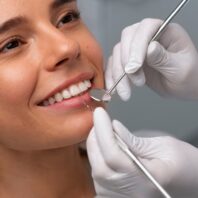
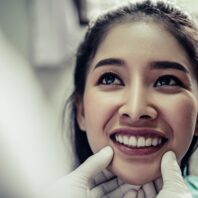
Macro-Aesthetics: The Smile Arc and Buccal Corridor
While individual tooth shape governs the micro-aesthetics, the macro-aesthetics—how the entire dental arch interacts with the lips and facial soft tissues—determine the ultimate harmony of the smile. A mathematically perfect set of teeth will still appear artificial if it does not respect the patient’s unique facial architecture.
[Image illustrating the ideal smile arc following the curvature of the lower lip and the management of the buccal corridor]
The most critical macro-aesthetic element is the “smile arc.” This is the imaginary curve formed by the incisal edges of the upper teeth. In a youthful, aesthetically pleasing smile, this curve should run perfectly parallel to the natural curvature of the patient’s lower lip when smiling. A flat smile arc, often the unintended result of severe tooth wear or poorly executed orthodontics, ages the patient and creates an unnaturally rigid appearance. Another vital component is the “buccal corridor,” the dark, negative space visible between the outer surfaces of the upper teeth and the corners of the lips (the commissures). If a dental arch is too narrow, the buccal corridors appear excessively large, making the smile look constricted and the teeth appear as an isolated block in the center of the mouth. A skilled cosmetic dentist will often design veneers or crowns to slightly widen the premolars and molars, effectively filling this negative space to create a broad, expansive, and highly engaging smile that illuminates the entire face.
The Social and Professional ROI of Dental Rehabilitation
The culmination of these precise biomechanical and aesthetic adjustments yields a profound psychological return on investment (ROI) for the patient. Clinical psychology heavily documents the “halo effect”—a cognitive bias where the perception of one positive trait (such as physical attractiveness) subconsciously influences the perception of other unrelated traits, such as intelligence, competence, and reliability.
Patients who undergo comprehensive smile makeovers frequently report a dramatic reduction in social anxiety and a surge in psychosocial well-being. They no longer employ defense mechanisms, such as covering their mouths when laughing or avoiding photographic documentation. This newfound lack of inhibition translates directly into enhanced professional performance and interpersonal relationships. When an individual smiles without hesitation, they project unwavering confidence, a trait that is highly valued in leadership, negotiations, and social networking. The eradication of dental insecurity frees the patient’s cognitive bandwidth, allowing them to engage with the world authentically and assertively.
Transforming the psychological profile of a smile demands a clinical environment that completely transcends the outdated “one-size-fits-all” approach to cosmetic dentistry. It requires a deep synthesis of advanced medical engineering and elite artistic intuition. Turkeyana has established itself as a global authority in this highly nuanced medical frontier by prioritizing deeply individualized, face-driven diagnostics. By utilizing state-of-the-art Digital Smile Design (DSD) protocols, the specialized prosthodontic board at Turkeyana captures ultra-high-definition dynamic video and 3D facial scans of every international patient. This allows the clinical team to meticulously calculate the golden proportions, evaluate the smile arc, and design a provisional trial smile that the patient can physically “test drive” before any permanent clinical intervention occurs. By empowering patients to co-design their restorations and utilizing the world’s finest master ceramists to fabricate hyper-realistic, biomimetic porcelain, Turkeyana guarantees an aesthetic outcome that is not merely physically flawless, but psychologically transformative. Entrusting a facial aesthetic rehabilitation to Turkeyana ensures that the resulting smile is an authentic, powerful reflection of the individual’s true character and boundless potential.
Your feedback helps us improve.
Thank you for your feedback.