Table of Contents
- A Step-by-Step Journey to a Functional Bite
- Phase 1: The “Digital Twin” Diagnosis
- Phase 2: The Foundation (Periodontics and Surgery)
- Phase 3: The “Architectural” Lift (VDO)
- Phase 4: The “Test Drive” (The Provisional Phase)
- Phase 5: The Materialization (Porcelain and Zirconia)
- Phase 6: The “Occlusal Equilibrium” (The Fine Tuning)
- Systemic Impact: Digestion and Posture
- The “Dental Tourism” Logistics for FMR
- Frequently Asked Questions (FAQ)
- The Second Act of Your Life


A Step-by-Step Journey to a Functional Bite

The human mouth is an engineering marvel. It is a machine designed to withstand massive pressure, crushing food with a force of up to 200 pounds per square inch, thousands of times a day, for decades. But like any complex machine, it can experience system failure. Years of grinding (bruxism), acid erosion, gum disease, or missing teeth can lead to a collapse of the entire oral ecosystem. This isn’t just about a “bad smile”; it is about chronic headaches, digestive issues, jaw pain, and a prematurely aged appearance.
In 2026, we don’t just patch these problems one by one. We perform a Full Mouth Restoration (FMR). This is the “Formula 1” of dentistry—the intersection of biology, physics, and art. It is a comprehensive reboot of the entire oral cavity, rebuilding the bite from the ground up to ensure that the teeth, the muscles, and the jaw joints work in perfect harmony. For the patient, it is often a journey from chronic discomfort to total liberation. It is not just about fixing teeth; it is about giving you your life back.
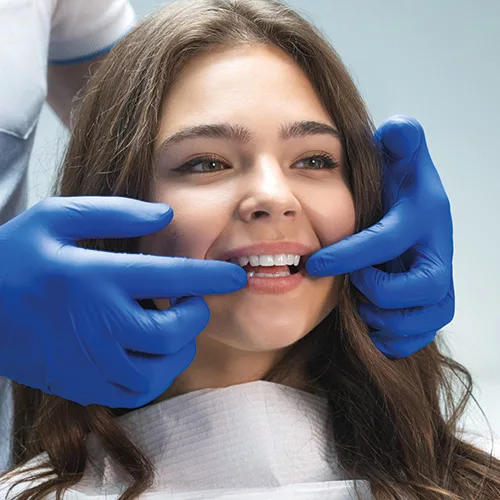


Phase 1: The “Digital Twin” Diagnosis
In the past, a dentist might have looked at your teeth and said, “Let’s put crowns on these.” In 2026, we will start with Neuromuscular Analysis. Before we touch a single tooth, we must understand the relationship between your jaw joint (Temporomandibular Joint – TMJ) and your muscles.
We create a “Digital Twin” of your mouth using:
- CBCT (Cone Beam Computed Tomography): A 3D x-ray that maps your bone volume, nerve paths, and sinus cavities.
- Intraoral Scanning: Creating a sub-millimeter accurate map of your current teeth and gums.
- Digital Jaw Tracking (K7 Evaluation): Sensors track the movement of your jaw in real-time to identify the “Resting Position”—the precise point where your jaw muscles are most relaxed.
Many patients needing full mouth restoration have a “pathologic bite.” Their teeth force their jaw into a strained position every time they close their mouth, causing migraines and neck pain. The goal of Phase 1 is to find your “True Bite”—the position where your muscles are happy and your joints are unloaded. We aren’t just rebuilding teeth; we are resetting the machine to its factory settings.
Talk to a Turkeyana consultant
Free evaluation and an all-inclusive quote within 24 hours.
Phase 2: The Foundation (Periodontics and Surgery)
You cannot build a skyscraper on a swamp. Before we place any porcelain, the biological foundation must be solid.
- Infection Control: Any hopeless teeth are extracted. Any active gum disease (periodontitis) is treated, often using Laser-Assisted New Attachment Procedure (LANAP) which kills bacteria without cutting the gums.
- Implant Placement: If teeth are missing, titanium implants are placed during this phase. In 2026, we use “guided surgery” to place them in the exact position needed to support the future bite forces.
- Bone Grafting: If the jaw has atrophied, we rebuild the bone volume.
This phase is often the “quiet phase.” It requires healing. Depending on the severity, there might be a waiting period of 3 to 4 months for the bone to integrate with the implants (Osseointegration). During this time, the patient wears high-quality temporary restorations, so they are never without teeth.
Phase 3: The “Architectural” Lift (VDO)
This is the magic of Full Mouth Restoration. We address the Vertical Dimension of Occlusion (VDO).
As discussed in previous articles, worn-down teeth cause the face to collapse. In this phase, we calculate exactly how much height needs to be added to the teeth to restore the face to its youthful proportions.
We don’t guess. We use the data from the Digital Twin. We might determine that the patient needs 3mm of added height on the molars to uncompress the TMJ.
The dentist then prepares the teeth (removing old fillings, decay, and shaping them) to receive the new restorations. This is a long appointment, often done under sedation. The patient leaves this appointment with a “prototype” smile—a full set of hard plastic (PMMA) temporaries that mimic the final design exactly.
Phase 4: The “Test Drive” (The Provisional Phase)
In 2026, we will never go straight to the final porcelain. We require a “Test Drive.”
The patient wears the PMMA prototypes for a few weeks or even months. This is a critical stress test.
- The Speech Test: Do you lisp? Do the “S” and “F” sound crisp?
- The Chewing Test: Can you eat a steak comfortably? Does your jaw feel tired?
- The Aesthetic Test: Is the smile too white? Are the teeth too long?
This provisional phase is the safety net. If the patient feels a click in their jaw, we adjust the plastic. If they bite their cheek, we reshape the plastic. We tweak the prototype until the patient says, “I forget I have teeth.” Only when the function is invisible do we proceed to the final step.
Phase 5: The Materialization (Porcelain and Zirconia)
Once the prototype is validated, we simply copy it. We scan the temporaries and tell the lab: “Make exactly this, but in ceramic.”
- Posterior (Back Teeth): We typically use Monolithic Zirconia. These are the workhorses. They need to withstand the 200 PSI of chewing force without cracking.
- Anterior (Front Teeth): We typically use Layered Zirconia or E-max. These are the show ponies. They provide the translucency, texture, and light reflection that creates a beautiful smile.
The final bonding appointment is a celebration. Piece by piece, the full arch is cemented into place. The bond is chemical and mechanical, turning the tooth and the restoration into a single fused unit.
Phase 6: The “Occlusal Equilibrium” (The Fine Tuning)
The restoration isn’t finished when the teeth are glued in. The final step is T-Scan Occlusal Analysis.
We use a digital sensor (a thin foil you bite on) that measures the force and timing of your bite. We can see if one molar is hitting 0.01 seconds before the others.
- Why does this matter? If one tooth hits high, it triggers a nerve feedback loop that tells the muscles to clench. This causes pain and can break the new porcelain.
- The Adjustment: The dentist makes microscopic adjustments (measured in microns) until the bite force is perfectly distributed across the arch. When you close your mouth, all teeth should touch simultaneously with equal pressure. This is “Occlusal Zen.”
Systemic Impact: Digestion and Posture
The impact of FMR extends far beyond the mouth.
- Digestion: Digestion begins in the mouth. If you cannot chew food properly (mastication), you swallow large chunks. This strains the stomach and reduces nutrient absorption. Patients often report that their acid reflux or bloating disappears after restoration because they can finally chew their food to a pulp.
- Posture: The jaw is connected to the neck muscles. A misaligned bite often pulls the head forward, leading to chronic neck and shoulder tension (“Text Neck” exacerbated by dental issues). Correcting the jaw position often leads to an immediate improvement in posture and a reduction in tension headaches.
The “Dental Tourism” Logistics for FMR
How does one manage such a complex procedure abroad? In 2026, the protocol for international FMR is streamlined into two visits.
- Visit 1 (5-7 Days): Diagnostics, surgery (implants/extractions), preparation of teeth, and placement of the “Test Drive” temporaries. You go home with a functional, beautiful (but plastic) smile to heal and test the bite.
- Healing Period (3-6 Months): You live your life at home. This allows the implants to fuse and the gums to shrink/heal to their final position.
- Visit 2 (7-10 Days): Taking the final impressions (or scans), creating the Zirconia masterworks, and final cementation.
This split approach ensures safety. We never rush biology.
Frequently Asked Questions (FAQ)
- Is Full Mouth Restoration painful?
The appointments are long (3-4 hours), so we almost always use IV Sedation. You sleep through the work. Post-operatively, there is soreness, especially if implants were placed, but it is managed with medication. Most patients say the relief from their chronic tooth pain outweighs the surgical discomfort almost immediately.
- Can I keep some of my natural teeth?
Yes. FMR does not mean “pulling everything out.” It means restoring everything. If a tooth has a healthy root, we save it and put a crown on it. We only extract teeth that are structurally unsound. The final result is often a mix of crowns on natural teeth and bridges/implants where teeth were missing.
- How long will a Full Mouth Restoration last?
With Zirconia materials and a balanced bite, these restorations can last 20 to 30 years or longer. The “weak link” is usually not the porcelain, but the gum health. If you don’t floss, you can lose the bone supporting the expensive work. Regular hygiene is the warranty.
- Will my face look different?
Yes, in a good way. By restoring the vertical height, we smooth out facial wrinkles and define the jawline. However, we are careful not to change your identity. We use old photos of you to recreate the tooth shapes you had in your youth, ensuring you still look like “you”—just refreshed.
- Is it worth the cost?
FMR is the most expensive procedure in dentistry. However, piecemeal dentistry (fixing one tooth every year) often costs more in the long run and never solves the underlying bite issue. FMR is a “buy it once” investment in total health. When you factor in the elimination of pain and the ability to eat any food you want for the rest of your life, the ROI is incredibly high.
The Second Act of Your Life
Full Mouth Restoration is more than a medical procedure; it is a rebirth. It marks the end of a chapter defined by pain, limitation, and self-consciousness, and the beginning of a “Second Act” defined by confidence and vitality. It is the ultimate commitment to your own longevity. In 2026, you do not have to accept the decline of your oral function as a natural part of aging. You have the option to rebuild. At Turkeyana, we bring together the world’s most advanced diagnostic technology, the strongest materials, and the most skilled neuromuscular dentists to guide you through this transformation, ensuring that your new smile is not just a cosmetic layer, but a fully functional machine built to power your future.
Your feedback helps us improve.
Thank you for your feedback.