Table of Contents

Dentistry has long operated on an aggressive restorative model. For decades, when a posterior tooth suffered moderate to severe structural damage from decay or trauma, the default clinical protocol was frequently the placement of a full-coverage dental crown. While modern crowns provide undeniable strength and aesthetic appeal, they demand a profound biological sacrifice. Today, the global dental community is undergoing a massive clinical paradigm shift driven by the philosophy of biomimetics, a highly specialized discipline focused on preserving natural tissue and precisely replicating the biomechanical properties of the intact human tooth. At the forefront of this tissue-saving revolution are indirect restorations: inlays and onlays. These highly engineered, precisely milled ceramic or composite inserts offer a sophisticated, conservative alternative to traditional crowns, effectively bridging the clinical gap between a simple filling and a total prosthetic overhaul.
The Biological Cost of Full-Coverage Crowns
To truly appreciate the clinical value of an inlay or onlay, one must first critically examine the biological cost associated with a traditional dental crown. Preparing a tooth to receive a full-coverage crown requires a procedure known as circumferential reduction. This means the clinician must utilize a high-speed diamond bur to shave down the entire perimeter and biting surface of the tooth, often permanently removing up to 70 percent of healthy, sound coronal tooth structure just to create adequate physical space for the restorative material.
This aggressive mechanical preparation traumatizes the underlying dentin and brings the drill perilously close to the dental pulp (the highly vascularized nerve chamber). Clinical studies indicate that a significant percentage of teeth aggressively prepared for full crowns eventually require endodontic therapy (root canals) due to the irreversible pulpal inflammation caused by this extensive structural removal. Furthermore, cutting away the rigid outer enamel shell permanently alters the tooth’s natural flexibility, making the remaining narrow root structure significantly more susceptible to catastrophic, non-restorable vertical fractures under heavy masticatory forces over time.
Talk to a Turkeyana consultant
Free evaluation and an all-inclusive quote within 24 hours.
Defining the Anatomy: Inlays vs. Onlays
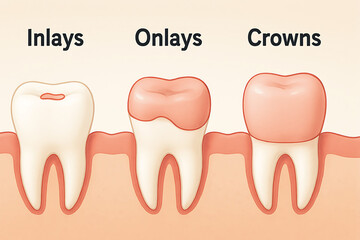
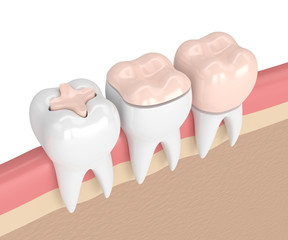
Inlays and onlays, collectively categorized as partial-coverage restorations, bypass this destructive cycle by replacing only the specific portion of the tooth that is damaged or decayed, leaving the healthy anatomy entirely untouched.
[Image comparing the anatomical design and structural coverage of a dental inlay, onlay, and full crown]
An inlay is clinically indicated when the structural damage is strictly confined within the cusps (the raised points) of a posterior molar or premolar. It generally mirrors the exact dimensions of a large traditional filling. However, unlike a direct composite filling which is packed into the tooth as a soft resin and cured in the mouth an inlay is custom-milled outside the oral cavity from a solid block of high-strength ceramic.
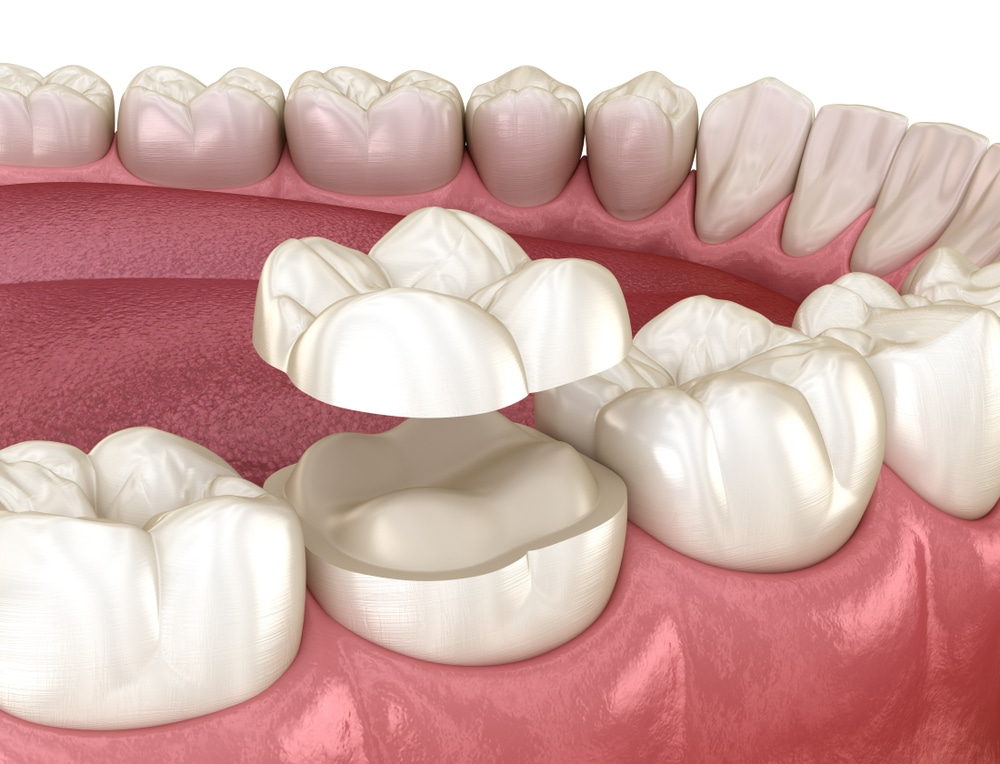
An onlay represents a more extensive structural repair. When decay, a massive old amalgam filling, or a fracture undermines one or more of the tooth’s cusps, the structural integrity of that wall is critically compromised. An onlay is meticulously designed to drape over these compromised points, effectively rebuilding the biting surface and protecting the weakened enamel walls from splitting under the immense forces of chewing. Crucially, it achieves this structural reinforcement without shaving down the healthy circumference of the tooth at the gingival margin.

The Science of Biomimetic Adhesion
The unparalleled success of these conservative restorations relies entirely on the advanced science of adhesive dentistry. Traditional crowns are often held in place by mechanical retention and luting cements, which rely heavily on the physical friction created by the specifically angled, shaved tooth stump. In stark contrast, inlays and onlays utilize a highly complex micromechanical and chemical bonding protocol to integrate with the tooth.
During the bonding phase, the clinician utilizes highly specific mild acids to selectively etch the microscopic enamel rods and the underlying porous dentinal tubules. A sophisticated bonding resin is then applied, penetrating these microscopic pores and chemically cross-linking with the internal, acid-etched surface of the ceramic restoration. This precise process creates a “hybrid layer” that effectively fuses the ceramic to the natural tooth, hermetically sealing the vulnerable dentin against bacterial microleakage. By utilizing biomimetic materials like Lithium Disilicate (E.max) or advanced composite resins materials that closely mimic the natural stiffness, modulus of elasticity, and light-reflecting properties of human enamel the restored tooth flexes, absorbs, and disperses occlusal stress exactly as a natural tooth would.
Clinical Superiority Over Direct Composites
While direct composite resin fillings are excellent for addressing small to moderate cavities, they possess severe biomechanical limitations when utilized to span massive areas of missing tooth structure. As a direct composite material is photo-polymerized (cured with a blue light), it inevitably undergoes polymerization shrinkage. In a massive cavity, this shrinkage can pull the material away from the cavity walls, causing severe postoperative sensitivity, micro-cracks in the remaining delicate enamel, and an immediate pathway for recurrent decay.
Because inlays and onlays are manufactured extraorally in a highly controlled dental laboratory or via highly precise CAD/CAM milling machines, they do not shrink inside the tooth. They offer vastly superior anatomical contours, allowing for perfect contact points with adjacent teeth to prevent painful food impaction. Furthermore, their highly polished, dense ceramic surfaces flawlessly resist plaque accumulation and dietary staining far better than standard filling materials, ensuring decades of functional and aesthetic stability.
Executing the highly technique-sensitive protocols of biomimetic adhesive dentistry requires an institution deeply committed to tissue preservation, elite material science, and uncompromising clinical precision. Turkeyana champions this conservative medical philosophy, ensuring that international patients do not sacrifice their healthy, natural tooth structure unnecessarily. By utilizing ultra-precise intraoral optical scanners and state-of-the-art, in-house CAD/CAM milling centers, the expert prosthodontic board at Turkeyana custom-fabricates flawless, high-strength ceramic inlays and onlays tailored to the micro-anatomy of the individual patient. This fully digital workflow allows for the rapid delivery of restorations that perfectly mimic the biomechanical resilience and aesthetic brilliance of natural enamel. For patients seeking to repair severely decayed or fractured teeth with the absolute highest degree of medical integrity, Turkeyana provides a world-class, minimally invasive pathway that permanently preserves their biological foundation while fortifying the long-term health and functional beauty of their smile.
Your feedback helps us improve.
Thank you for your feedback.